
Talking About Harm Without Saying “Abuse” in Your Custody Evaluation
Precision is important.


You know what you and your children have endured. You call it abuse—and rightly so. But in the sterile, often literal environment of a custody evaluation, simply using the word “abuse” can be counterproductive. Evaluators, trained in legal definitions, often look for overt physical harm or clear neglect, potentially missing the insidious patterns of emotional, psychological, or coercive control that characterize narcissistic abuse.
When you use the term “abuse” broadly, it can easily be dismissed. This is particularly dangerous because courts often lack recognition for non-physical trauma like financial abuse, spiritual abuse, or coercive control—forms of harm that are nearly impossible to “prove” by the court’s strict, criminal standards.
This post will guide you on how to articulate the harm experienced by you and your children using precise, descriptive language that communicates the gravity of the situation without triggering the evaluator’s skepticism or bias.
Why is Word “Abuse” a Potential Trap?
At The Custody Blueprint®, we are more than fully aware that in high-conflict custody cases, protective parents face the agonizing risk that their truthful claims will be twisted into evidence against them. Your core goal is to demonstrate unwavering credibility.
1. The “Custody Strategy” Trap
The most dangerous perception is that you are using the allegation purely for litigation leverage to gain custody. If you lead every conversation with “abuse” without providing detailed, factual context, the evaluator may conclude you are overly focused on vilifying your co-parent.
AVOID: Language that frames the issue as a personal, zero-sum battle.
USE: Language that frames the issue as a need for stability and professional/the court’s intervention (e.g., “I need the court’s help establishing boundaries to ensure our children’s emotional stability“).
2. The Proof Barrier for Coercive Control
For non-physical abuse—like coercive control, financial exploitation, or emotional manipulation—you often lack police reports or medical records. Even officers and doctors are not often trained in what abuse looks like, especially coercive control. In the eyes of the court, an allegation of abuse is often weighted only by the level of “hard evidence” available. If you don’t have that, a blanket accusation can be dismissed, and you risk being labeled as “over-exaggerating” or “unreasonable.”
A great example of this is with “horsing around.” More than a few survivor parents have shared that during their relationship with their co-parent, playful roughhousing between them turned into roughly being pinned down or thrown across the room simply because of a playful blow that landed on the abuser too hard for their own fragile egos. Yet when the protective parent shares this type of incident, invariably, the evaluator notes it as “exaggeration.”
Your strategy must shift from labeling the behavior to meticulously describing the actions and, most importantly, their observable impact on the child’s life.
Your Toolkit: Descriptive Language That Works
Instead of leading with “abuse,” use descriptive adjectives and verbs that paint a clear picture of the behavior and its effects. These terms are easier to support with your logs and documentation.
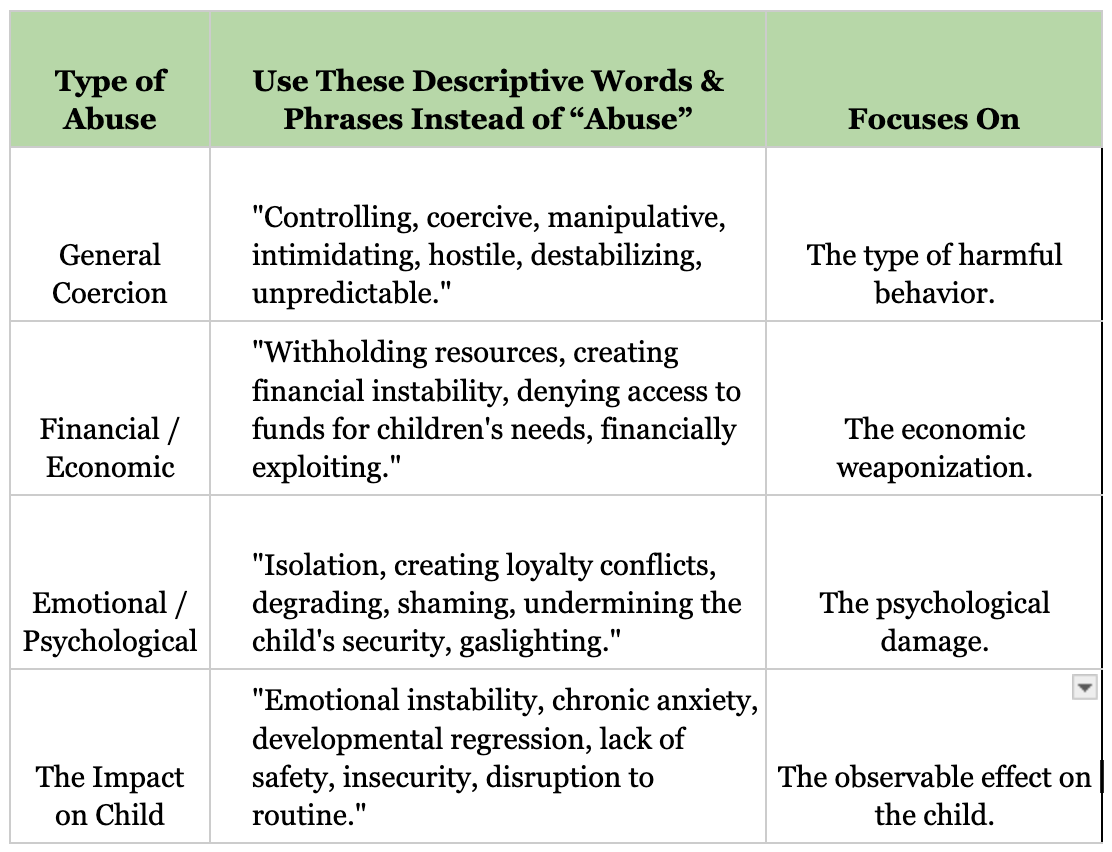
Strategic Steps: How to Talk About Harm
When you need to convey the depth of harm, focus on the following three elements, connecting them directly to your evidence logs. Here again, the focus is on not labeling (or diagnosing), but rather showing the patterns and proving its impact on your children:
1. Describe the Observable Behavior (Factual)
State what happened without judgment or interpretation, and focused on actions.
Example (Financial Abuse): “He systematically denied me access to the joint account and withheld funds designated for our toddler’s medical expenses for three months.” (In this example, you’d have bank statements and medical bills as part of your body of evidence).
Example (Loyalty Conflict): “He repeatedly tells our children negative things about me, asks them to relay messages, or criticizes me in their presence, creating a demonstrable loyalty conflict.” (In this example, you’d show communication logs and notes of children’s quotes).
2. Explain the Pattern (Consistency)
Evaluators look for patterns, not isolated incidents.
Key Phrase: “This wasn’t a one-off event; it’s happened at almost every exchange over the past seven months.”
Actionable Statement: “There’s a predictable cycle where [co-parent’s name] will sabotage our children’s activities by withdrawing consent at the last minute, resulting in a lot of disappointment for the kids and wasted non-refundable fees I don’t end up getting reimbursed for.”
3. Detail the Impact on the Child (Child-Focused)
This is the most critical component. Connect your co-parent’s behavior directly to your child’s well-being and emotional response.
Example: “The isolation and degradation inflicted has led to Tommy’s expressing self-doubt and social withdrawal, as observed by their teacher and noted in their recent counseling report.”
Example: “The atmosphere of chronic unpredictability created by [co-parent’s name]’s constant yelling has resulted in our children showing increased physical symptoms of stress, such as headaches and difficulty sleeping.”
By meticulously describing the behavior, identifying the pattern, and articulating the precise impact on your children, you build a powerful, undeniable case. Your precise language becomes your strongest defense, ensuring the full scope of your children’s experience is understood.
Take time to sit and write out and get used to using language like the examples here.
Reneé Rodriguez is an evaluation prep specialist who works as a custody strategist, certified DV advocate, divorce mediator and parent coordinator. She is also the creator of The Custody Blueprint®. For more information on her Eval Prep Incubator, please start with her free master class, “Preparing for a Custody Evaluation with a Narcissistic Co-Parent”.
Disclaimer: This post provides general information and should not be considered legal advice or therapy. Every custody case is unique, and it is strongly advised to consult with a qualified family law attorney for advice tailored to your specific situation.