
Beyond “Alienation”: Decoding the Child’s Reality in the Shadow of Coercive Control


When a custody evaluator steps into your life, they aren’t just looking at schedules and bedtimes; they are looking for their idea of a “narrative” (even as evidence is needed for proof of that narrative). In high-conflict cases involving domestic abuse, that narrative often becomes a battle between two versions of reality.
One parent presents a veneer of reasonableness—claiming they are just a “disciplinarian” or that the child prefers their home. The other parent (the protective parent) often struggles to explain a much darker, invisible reality—coercive control. To help an evaluator see past the veneer, you must shift from emotional defense to clinical observation. You aren’t “complaining” about the other parent; you are identifying their tactics of control and their direct impact on the child’s neurobiology and sense of self.
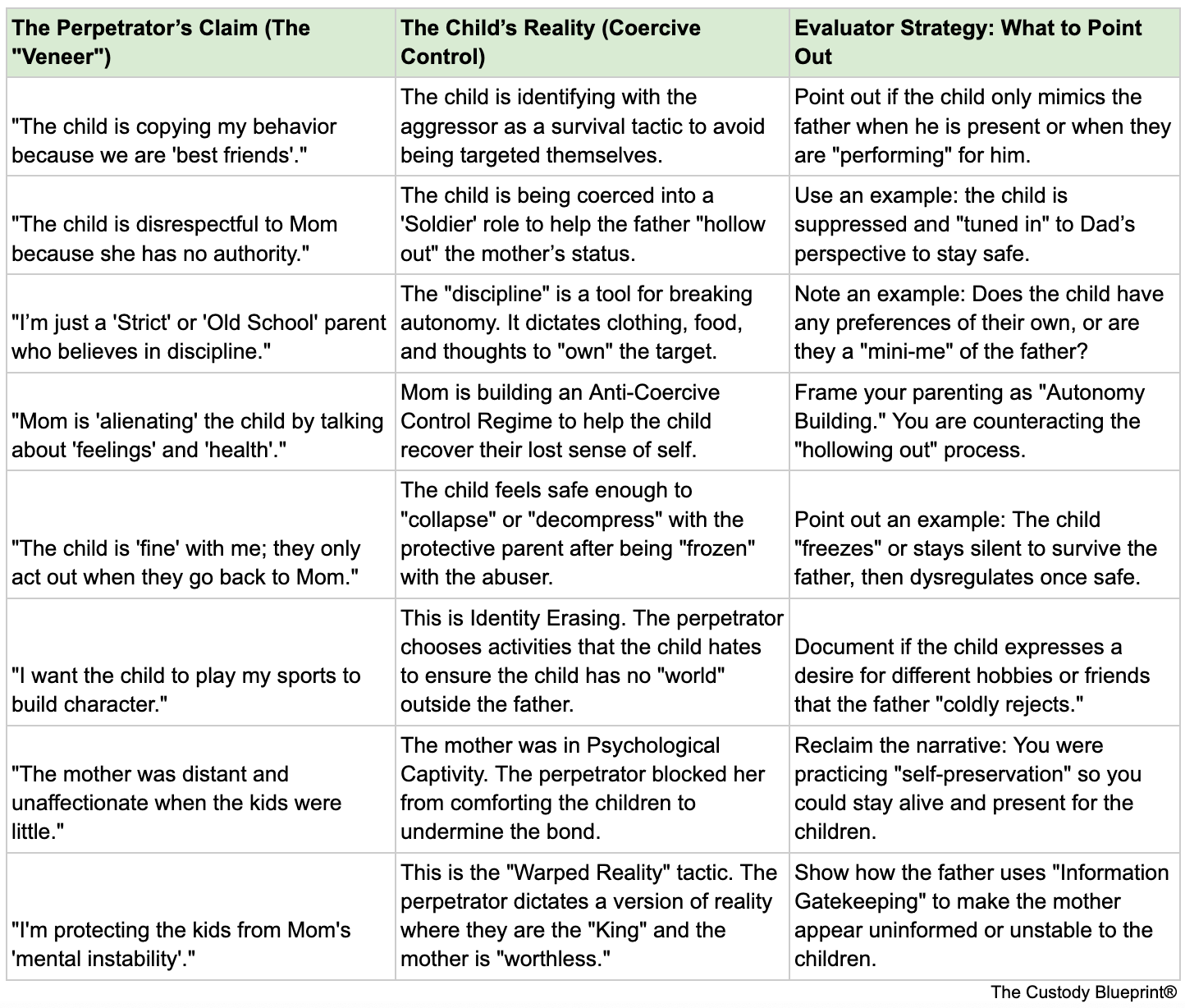
The following table is designed to help you decode the behaviors often seen in children trapped in a coercive control dynamic. Influenced by Dr. Emma Katz’s teachings, it moves the focus away from the father’s “rights” and toward the child’s survival strategies.
Decoding “Identifying with the Aggressor”
Evaluators often mistake a child’s mimicry of an abusive parent for a close bond. Research shows the opposite: children in these environments often freeze or fawn (appease the abuser) to survive. When a child mimics an abusive parent’s aggression toward a protective parent, they are performing a role in a forced reality where the abuser is the ruler.
The “Hollowing Out” of the Child
Coercive control aims to break a target down and hollow them out. In children, this shows up as choicelessness. If the evaluator sees a child who has no preferences, eats only what one parent likes, and dresses exactly like the one parent, they are looking at a child who has lost their sense of self. This is a clinical symptom of trauma, not good discipline.
The Anti-Coercive Control Regime
As a protective parent, your role is to create a “reversed, mirror-image regime.” While the abuser creates despair and choicelessness, you must create hope and empowerment.
Where the abusive parent strips identity: You provide makeover sessions, wig-wearing fun, or hair experimentation to help the child find their preferences.
Where the abusive parent creates isolation: You proactively build the child’s village of supportive, non-aligned family and friends.
Where the abusive parent dictates reality: You validate the child’s “emotional thermostat,” helping them trust their own gut again.
Strategic Presentation Tips
When discussing these behaviors with your evaluator:
Use the word “Regime”: It describes a systemic environment rather than a one-off “fight.”
Externalize the Behavior: Don’t say “My child is being mean.” Say, “My child is currently utilizing a survival-based performance to appease their father’s coercive regime.”
Focus on Autonomy: Highlight how you are rebuilding the child’s ability to have a choice—which is the direct antidote to the “choicelessness” of abuse.
By naming the tactics, you lift the fog. You show the evaluator that you aren’t an “angry ex”—you are the architect of a recovery regime that is fighting for your child’s very soul.
Reneé Rodriguez is an evaluation prep specialist who works as a custody strategist, certified DV advocate, divorce mediator and parenting coordinator. She is also the creator of The Custody Blueprint®. For more information on her Eval Prep Incubator, please start with her free master class, “Preparing for a Custody Evaluation with a Narcissistic Co-Parent”.
Disclaimer: This post provides general information and should not be considered legal advice or therapy. Every custody case is unique, and it is strongly advised to consult with a qualified family law attorney for advice tailored to your specific situation.
A Note on My Toolkit: > You may notice that my posts feature detailed charts and specific illustrations. I use AI to help me “translate” dense scientific and legal data into the tools you see here. This allows me to spend more time focusing on the strategies that matter most to your case while ensuring the presentation and my writing are clear, professional, and ready for your custody evaluation prep and potentially your body of evidence (BOE). In other words, my use of AI is ancillary.